
Industrial Pumps & Fluid Handling: Selection, Specification and Supply for Process Applications
Category: Process Equipment — Pumps & Fluid Handling
Application categories: Chemical & Petrochemical, Oil & Gas, Water & Wastewater Treatment, Food & Beverage Processing
A pump failure in a process plant is rarely just a mechanical event. It is a process interruption, a maintenance intervention, a production loss, and in some applications a safety incident. The pump is the heart of a fluid handling system — when it stops, everything downstream stops with it. Selecting the right pump for the application, specifying it correctly, and sourcing it from a manufacturer with genuine process industry capability are decisions that determine years of reliable service or years of recurring problems.
This guide covers the principal pump types used in process industry applications, the selection criteria that govern the choice between them, the specification language that communicates requirements precisely to manufacturers, and the supply chain considerations that matter when sourcing industrial pumps in European and international markets.
1. Pump types and where they belong
Centrifugal pumps
The centrifugal pump is the most widely used pump type in process industry applications — chemical processing, water and wastewater treatment, power generation cooling circuits, general fluid transfer. Its operating principle is simple: a rotating impeller imparts kinetic energy to the fluid, which converts to pressure as it decelerates through the volute casing.
Centrifugal pumps handle large flow volumes efficiently at moderate pressures. They are continuous-duty machines suited to steady-state process flow. They are not suited to high-viscosity fluids — efficiency drops sharply as viscosity rises above approximately 200 centipoise — and they cannot handle fluids containing significant solids content without impeller wear that shortens service life unacceptably.
The operating point — the intersection of the pump curve and the system resistance curve — determines flow rate and pressure delivery in service. A pump selected without reference to the full system resistance curve, including static head, pipe friction losses, and control valve pressure drops, will not operate at the intended duty point. This is one of the most common specification errors in pump procurement, and one that a competent pump manufacturer will identify during application review.
Single-stage centrifugal pumps handle the majority of general process applications. Multistage centrifugal pumps — where the fluid passes through multiple impeller stages in series — develop higher pressures suitable for boiler feed, high-pressure injection, and pipeline booster service.
Positive displacement pumps
Where centrifugal pumps handle flow rate efficiently, positive displacement pumps handle pressure and viscosity. A positive displacement pump moves a fixed volume of fluid per revolution or stroke regardless of system pressure — within mechanical limits. Flow rate is determined by speed, not by system resistance.
This characteristic makes positive displacement pumps the correct choice for high-viscosity fluids — gear pumps, screw pumps, and lobe pumps handle viscosities from light oils through heavy polymers and molasses — and for metering applications where precise, repeatable flow rate regardless of pressure variation is required.
Gear pumps are the workhorse of viscous fluid transfer — lubricating oil systems, hydraulic power units, polymer processing, bitumen handling. Their close-tolerance gear mesh creates the positive displacement action; fluid viscosity actually lubricates the gears, which means gear pumps require a minimum fluid viscosity to operate correctly. Running a gear pump on water or thin solvents causes accelerated wear.
Screw pumps handle higher viscosities and larger flow rates than gear pumps, with lower shear — important in food processing and polymer applications where product degradation under high shear is unacceptable.
Lobe pumps — where two synchronised rotors create the displacement action without contact — are the standard choice for hygienic process applications: food and beverage, pharmaceutical, biotechnology. The absence of metal-to-metal contact in the pumping chamber and the cleanability of lobe pump internals make them suitable for CIP (clean-in-place) and SIP (sterilise-in-place) applications where gear pumps are not.
Diaphragm pumps
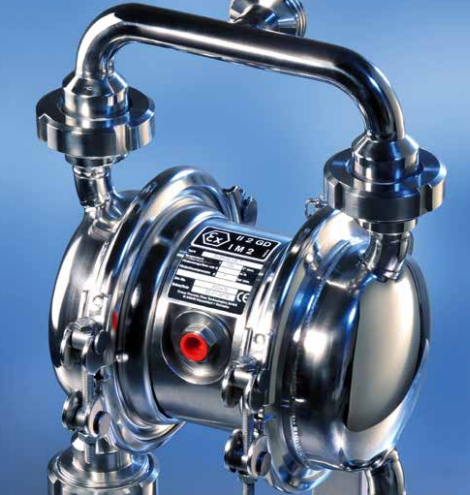
Air-operated double diaphragm (AODD) pumps occupy a specific and important niche in process fluid handling — abrasive slurries, aggressive chemicals, shear-sensitive fluids, and applications requiring dry-run capability or the ability to handle entrained solids without damage.
The diaphragm separates the fluid completely from the pump mechanism — there is no rotating shaft seal in contact with the process fluid. This makes AODD pumps the correct choice for aggressive chemicals that would attack mechanical seals, for fluids containing abrasive particles that would wear impeller and seal surfaces, and for applications where pump dry-running is a realistic operational scenario.
AODD pumps are not continuous high-efficiency transfer pumps. Their pulsating flow output requires dampening where smooth flow is required downstream, and their air consumption at high flow rates makes them less economical than centrifugal pumps for steady-state large-volume transfer. They are application-specific tools, and recognising when the application calls for them is the mark of an experienced fluid handling engineer.
Peristaltic pumps
The peristaltic pump — where a rotor compresses a flexible tube, pushing fluid forward as the compression point moves along the tube — offers complete fluid isolation from the pump mechanism and gentle, low-shear fluid handling suited to pharmaceutical, biotechnology, and food processing applications.
Flow rate is precisely controllable by speed adjustment, making peristaltic pumps suitable for metering and dosing applications. Tube replacement is the primary maintenance activity — the tube is the wear item, and tube material selection for chemical compatibility and temperature range is the primary specification decision.
Reciprocating pumps
High-pressure reciprocating pumps — plunger pumps and piston pumps — develop pressures that centrifugal and most positive displacement pump types cannot reach: hydraulic fracturing pumps operating above 1,000 bar, high-pressure water jet systems, chemical injection pumps on offshore platforms injecting scale inhibitor or corrosion inhibitor into wellheads at pressures above pipeline pressure.
For process plant applications, reciprocating metering pumps — motor-driven plunger pumps with precise stroke length and speed adjustment — deliver accurate chemical dosing in water treatment, chemical processing, and oil and gas applications where the combination of high pressure and precise volume control is required.
2. Critical specification parameters
Pump specification for process applications involves a defined set of parameters that must be established before approaching manufacturers. Incomplete specifications result in pumps selected for nominal duty that perform poorly in actual service conditions.
Flow rate and pressure — the fundamental duty parameters. Flow rate must be specified as the required operating flow, not an estimated maximum. Pressure must include all components of system resistance: static head difference between suction and discharge, pipe friction losses at the specified flow rate, pressure drops across heat exchangers, filters, and control valves in the circuit, and back pressure at the discharge point.
Fluid properties — density, viscosity at operating temperature, vapour pressure, solids content and particle size, chemical composition, and any special handling requirements (shear sensitivity, hygiene requirements, flammability, toxicity). A pump selected without accurate fluid viscosity data will operate off its design curve in service.
Net Positive Suction Head available (NPSHa) — the suction conditions available to the pump, determined by suction pipe layout, fluid vapour pressure, and fluid density. NPSHa must exceed the pump’s NPSHr (required) by an adequate margin — typically one metre minimum, more for critical applications — to prevent cavitation. Cavitation — the formation and collapse of vapour bubbles within the pump — causes impeller erosion, vibration, and noise that progressively destroys the pump. It is one of the most common causes of premature pump failure and almost always results from inadequate suction condition analysis during specification.
Operating temperature — determines material selection for pump casing, impeller, and shaft seals, and affects fluid viscosity and vapour pressure calculations.
Duty type — continuous, intermittent, standby. Pumps in continuous process service require higher reliability standards than intermittent-duty transfer pumps. Standby pumps require automatic starting systems and regular test running to maintain readiness.
Mechanical seal specification — the shaft seal on a centrifugal or positive displacement pump is frequently the first point of failure in service. Single mechanical seals suit clean, non-hazardous fluids. Double mechanical seals with a pressurised barrier fluid between seal faces are specified for hazardous, toxic, or flammable fluids where external leakage is unacceptable. API 682 provides the recognised standard for mechanical seal systems in petroleum, petrochemical, and natural gas industry applications and is widely referenced beyond those sectors for demanding process applications.
3. Standards and certification
Process pumps in European installations are subject to the same Pressure Equipment Directive (PED 2014/68/EU) requirements as process valves — classification by fluid category, pressure, and size determines the conformity assessment category and CE marking requirement.
Beyond PED, the standards most frequently referenced in process pump specifications:
ISO 5199 / EN ISO 2858 — centrifugal pumps for chemical process service. Defines dimensional standards, materials, and performance requirements. Pumps built to this standard are interchangeable between manufacturers at equivalent duty points — an important consideration for installed plant where pump replacement without pipe modification is required.
API 610 — the dominant standard for centrifugal pumps in petroleum, petrochemical, and natural gas industry service. Specifies design requirements, materials, testing, and documentation significantly more stringent than general industrial standards. An API 610 pump costs more than a standard process pump at equivalent duty; the premium buys reliability, documentation, and the ability to source spare parts from multiple manufacturers.
API 676 — positive displacement rotary pumps for general refinery service.
ATEX — as with valves, motors and electrical components driving pumps in explosive atmosphere zones require appropriate ATEX certification for the zone category.
Hydraulic performance testing to ISO 9906 — specifies test methods and acceptance grades for centrifugal pump hydraulic performance. Grade 1 is the tightest tolerance; Grade 2 is standard commercial tolerance. Specifying the required test grade explicitly avoids disputes over performance acceptance at delivery.
4. Mechanical seal systems and the API 682 piping plans
API 682 defines a set of seal support system configurations — piping plans — that have become the standard language for mechanical seal specification in process industry applications worldwide, used well beyond the oil and gas sector for which they were originally developed.
The most commonly referenced plans:
Plan 11 — flush from pump discharge to seal chamber. The simplest and most common arrangement for clean, non-polymerising fluids. Pump discharge fluid flushes and cools the seal faces.
Plan 23 — dedicated recirculation circuit with a heat exchanger, cooling the seal flush fluid independently of pump discharge. Specified for hot water service and other applications where discharge fluid temperature is too high for direct seal flushing.
Plan 52 — unpressurised buffer fluid reservoir for double seals, with fluid at lower pressure than the process. Buffer fluid leakage to atmosphere is acceptable; process fluid leakage to buffer is detected by buffer fluid contamination.
Plan 53A — pressurised barrier fluid reservoir for double seals, with barrier fluid at higher pressure than the process. Process fluid cannot leak outward through the inner seal faces. Specified for toxic, hazardous, or flammable fluids where zero process leakage to atmosphere is required.
Specifying the appropriate API 682 seal arrangement and piping plan in the pump datasheet communicates seal requirements precisely and unambiguously to any pump manufacturer with process industry capability.
5. European pump manufacturers and the supply chain
European pump manufacturing is concentrated in Germany, Italy, the United Kingdom, Sweden, and the Netherlands, with significant capability also in France, Denmark, and Switzerland. The sector includes global groups — KSB, Sulzer, ITT, Flowserve, Grundfos, Wilo — and a large number of specialist manufacturers covering specific pump types, materials, or industry sectors with depth that generalist manufacturers cannot match.
The specialist manufacturers are frequently overlooked in procurement processes that default to global brand names. A German gear pump manufacturer with forty years of experience in polymer processing applications, whose engineering team has solved every viscosity and temperature challenge the sector presents, offers application knowledge that a general catalogue cannot contain. Finding these manufacturers, evaluating their capability, and establishing supply relationships is precisely the gap that structured industrial representation addresses.
For critical process applications, the evaluation criteria beyond price and delivery are: manufacturing quality system certification, hydraulic test facility capability (can they test to the specified duty in their own facility or must they subcontract?), material certification standards, spare parts availability and lead time, and field service capability in the installation country.
European positive displacement pump manufacturing has particular depth in Germany, where specialist manufacturers developed internationally recognised product lines in AODD and peristaltic pump technology from the 1970s onward. DEPA GmbH in Düsseldorf — originally part of an independent European process equipment group before acquisition by Crane — remains one of the most recognised AODD pump brands in global process industry applications. ELRO Pumpen GmbH, a peristaltic pump specialist brought into the same group, continues under Crane ownership. Both represent the kind of specialist depth that characterises the best of European process pump manufacturing: decades of application knowledge embedded in product design that catalogue suppliers cannot replicate.
A pump manufacturer without a European spare parts and service infrastructure is a supply risk for critical process plant regardless of initial purchase price.
Frequently asked questions
What causes pump cavitation and how is it prevented?
Cavitation occurs when the pressure at the pump suction falls below the vapour pressure of the fluid, causing vapour bubbles to form and then collapse violently as pressure recovers through the impeller. The collapse causes impeller erosion, vibration, and noise. Prevention requires ensuring the available Net Positive Suction Head (NPSHa) exceeds the pump’s required NPSH (NPSHr) by an adequate margin — achieved through correct suction pipe design, minimising suction pipe losses, and locating the pump as close to and as low as practical relative to the suction vessel.
When should a positive displacement pump be used instead of a centrifugal pump?
Positive displacement pumps are specified when fluid viscosity exceeds approximately 200 centipoise (where centrifugal pump efficiency drops unacceptably), when precise metered flow independent of system pressure is required, when the fluid contains abrasive solids that would erode centrifugal impellers, or when very high pressures are required beyond the practical range of centrifugal pump design.
What is API 610 and when is it required?
API 610 is the American Petroleum Institute standard for centrifugal pumps in petroleum, petrochemical, and natural gas industry service. It specifies design, materials, testing, and documentation requirements significantly more stringent than general industrial pump standards. It is typically required by specification on oil and gas projects, refineries, and petrochemical plants, and is increasingly referenced on demanding process plant projects outside those sectors where high reliability and full documentation are required.
What is the difference between a single and double mechanical seal?
A single mechanical seal has one pair of rotating seal faces between the process fluid and the atmosphere. It is suitable for clean, non-hazardous fluids where minor seal leakage is acceptable. A double mechanical seal has two pairs of seal faces with a barrier or buffer fluid between them. In a pressurised double seal arrangement (API Plan 53), the barrier fluid at higher pressure than the process ensures process fluid cannot leak to atmosphere — required for toxic, flammable, or environmentally hazardous fluids.
How do I specify a pump for a fluid I have limited data on?
Provide the manufacturer with the best available data on fluid density and viscosity at operating temperature, approximate chemical composition, solids content if any, and operating temperature range. A competent manufacturer will identify the data gaps and request the additional information needed before selecting pump materials and seal specification. If a manufacturer quotes without requesting fluid data beyond flow and pressure, treat that as a qualification concern.
manufacturers.wiki covers industrial manufacturing products, suppliers, certifications, and international sales channels. Articles are written from direct industry experience, not aggregated from secondary sources. For manufacturers in pumps, fluid handling, and process equipment seeking international representation, visit revrok.net.
Find manufacturers and suppliers
manufacturers.wiki maintains a directory of verified industrial manufacturers, suppliers, and export service providers. Browse company profiles, product categories, and editorial contributions by sector.
Above: DEPA® Air Operated Diaphragm Pumps. Stainless steel in highly sensitive food pumping application